
Curriculum Overview
On this page:
- Education for the 21st Century
- Student success through curriculum transformation
- Key features of redesigned curriculum
- Curriculum model
- Redesigned curriculum in action
- Indigenous perspectives and knowledge
- Program considerations
Education for the 21st Century
British Columbia has one of the best education systems in the world. Teachers are skilled, facilities are sound, and students are performing near the top of international assessments. Yet it is an education system modelled on the very different circumstances of an earlier century — when change was much more gradual than it is today. Conditions in the world are changing greatly and rapidly. Today’s students will grow into a world that is very different from and more connected than that of generations before.
To maintain high achievement, British Columbia must transform its education system to one that better engages students in their own learning and fosters the skills and competencies students will need to succeed. One focus for this transformation is a curriculum that enables and supports increasingly personalized learning, through quality teaching and learning, flexibility and choice, and high standards.
To guide the transformation, the province conducted reviews of trends in national and international jurisdictions and invited authorities on curriculum and assessment design to advise on proposed changes. In addition, as part of the work on core competencies, several commissioned researchers summarized the literature in critical thinking, creative thinking, and social and personal responsibility.
Student success through curriculum transformation
Today we live in a state of constant change. It is a technology-rich world, where communication is instant and information is immediately accessible. The way we interact with each other personally, socially, and at work has changed forever. Knowledge is growing at exponential rates in many domains, creating new information and possibilities. This is the world our students are entering.
British Columbia’s curriculum is being redesigned to respond to this demanding world our students are entering, To develop new models, we consulted with experts in the field. They suggested that to prepare students for the future, the curriculum must be learner-centred and flexible and maintain a focus on literacy and numeracy, while supporting deeper learning through concept- based and competency-driven approaches.
The redesign of curriculum maintains a focus on sound foundations of literacy and numeracy while supporting the development of citizens who are competent thinkers and communicators, and who are personally and socially competent in all areas of their lives. British Columbia’s redesigned curriculum honours the ways in which students think, learn, and grow, and prepares them for a successful lifetime of learning where ongoing change is constant.
The educated citizen
Personalized learning
Key features of BC’s Curriculum
At the heart of British Columbia’s redesigned curriculum are the Core Competencies, essential learning and literacy and numeracy foundations. All three features contribute to deeper learning.
Core competencies
Core Competencies underpin the curricular competencies in all areas of learning. They are directly related to the educated citizen and as such are what we value for all students in the system.
Essential learning
The curriculum for each subject area includes the essential learning for students, which represent society’s aspirations for B.C’s educated citizen. The redesigned curriculum develops around key content, concepts, skills and big ideas that foster the higher-order thinking demanded in today’s world.
Literacy and numeracy foundations
Literacy is the ability to understand, critically analyze, and create a variety of forms of communication, including oral, written, visual, digital, and multimedia, in order to accomplish one’s goals.
Numeracy is the ability to understand and apply mathematical concepts, processes, and skills to solve problems in a variety of contexts.
Literacy and numeracy are fundamental to all learning. While they are commonly associated with language learning and mathematics, literacy and numeracy are applied in all areas of learning.
Curriculum model
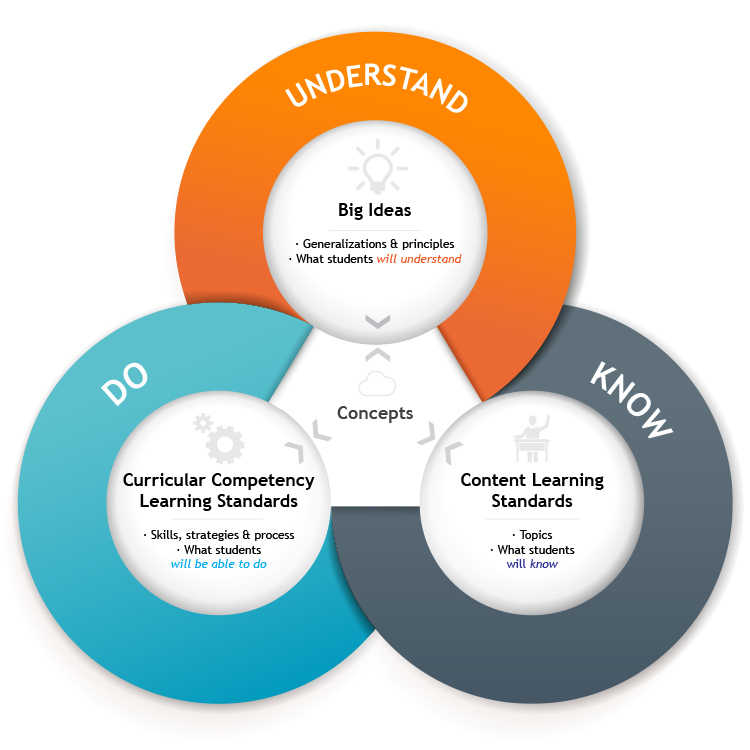
All areas of learning are based on a “Know-Do-Understand” model to support a concept-based competency-driven approach to learning.
Three elements, the Content (Know), Curricular Competencies (Do), and Big Ideas (Understand) all work together to support deeper learning.
Big Ideas (Understand)
The big ideas consist of generalizations and principles and the key concepts important in an area of learning. They reflect the “understand” component of the know-do-understand model of learning.
The big ideas represent what students will understand at the completion of the curriculum for their grade. They are intended to endure beyond a single grade and contribute to future understanding.
Content (Know)
The content learning standards — the “Know” of the know-do-understand model of learning — detail the essential topics and knowledge at each grade level.
Curricular Competencies (Do)
The curricular competencies are the skills, strategies, and processes that students develop over time. They reflect the “do” in the know-do-understand model of learning. While curricular competencies are more subject-specific, they are connected to the core competencies.
Concept-based, competency-driven curriculum
British Columbia’s redesigned curriculum brings together two features that most educators agree are essential for 21st-century learning: a concept-based approach to learning and a focus on the development of competencies, to foster deeper, more transferable learning. These approaches complement each other because of their common focus on active engagement of students. Deeper learning is better achieved through “doing” than through passive listening or reading. Similarly, both concept-based learning and the development of competencies engage students in authentic tasks that connect learning to the real world.
Concept-based learning
Competency-driven learning
Redesigned curriculum in action
When planning, it is important to begin with a broad understanding of the curriculum being used.
- The rationale and goals provide the context for the area of learning and make clear its contribution to the development of educated citizens
- The rationale and goals provide a broad instructional and assessment context for the area of learning
- The introduction to each area of learning provides specifics about features, structure, and important considerations of the curriculum
The curriculum for each area of learning is displayed in two ways—in HTML format on the website and in PDF or Word formats.
The curriculum website will continue to evolve in ways that support planning for learning. At this point, several features are available such as:
- A search engine to allow teachers to search for key words or select key elements from specific grades or areas of learning
- The results of the search can be exported into a Word document for further manipulation
- PDF or Word versions of the curriculum can be printed
- Some resources for planning are included now and will be further expanded in the future
This flexibility supports teachers to combine the learning standards in various ways. Teachers are encouraged to create courses, modules, thematic units or learning experiences that go beyond learning area borders to focus on students’ needs and interests or local contexts. The curriculum design and the website features provide the flexibility to serve the unique needs of classrooms, students, and teachers.
Flexible learning environments
ICT-enabled learning environments
Inquiry and question-based approaches
Collaboration with community
Indigenous perspectives and knowledge
British Columbia has long had the goal of improving school success for all Indigenous students. Achieving this goal will require that the voice of Indigenous people be heard in all aspects of the education system; the presence of Indigenous languages, cultures, and histories be increased in provincial curricula; and leadership and informed practice be provided.
At the same time, Indigenous perspectives and knowledge are a part of the historical and contemporary foundation of British Columbia and Canada. British Columbia’s education transformation therefore incorporates the Indigenous voice and perspective by having Indigenous expertise at all levels, ensuring that Indigenous content is a part of the learning journey for all students, and ensuring that the best information guides the work. An important goal in integrating Indigenous perspectives into curricula is to ensure that all learners have opportunities to understand and respect their own cultural heritage as well as that of others.
Over the past decade, British Columbia’s curriculum has integrated Indigenous content into specific courses. The redesigned curriculum builds on what has been learned and extends Indigenous perspectives into the entire learning journey, rather than into specific courses or grade levels. This means that from Kindergarten to graduation, students will experience Indigenous perspectives and knowledge as part of what they are learning. And because Indigenous perspectives and knowledge are embedded in the curriculum, they will naturally influence the ways in which students will be assessed.
The First Peoples Principles of Learning provided a crucial lens for teacher teams when drafting curricula, and all curriculum teams included Indigenous representation. The teams put great effort into embedding Indigenous knowledge and worldviews in curriculum in authentic and meaningful ways. Curriculum material was reviewed by our staff as well as by Indigenous teachers and other experts.
References to Indigenous perspectives and knowledge are both explicit and implicit in the redesigned curriculum and are evident in the rationale statements, goals, learning standards, and some of the elaborations. Rich instructional samples to inspire teaching and learning will be collected and shared online to provide examples of relevant teaching units and place-based learning. In all of the areas of learning, teachers are encouraged to teach in ways that respect the place in which the students are — to teach from within the school and its surrounding community.
Program considerations
Valuing diversity
British Columbia’s schools include young people of varied backgrounds, interests, and abilities. The Kindergarten to grade 12 school system focuses on meeting the needs of all students. When selecting specific topics, activities, and resources to support the implementation of the curriculum, teachers are encouraged to ensure that these choices support inclusion, equity, and accessibility for all students. In particular, teachers should ensure that classroom instruction, assessment, and resources reflect sensitivity to diversity and incorporate positive role portrayals, relevant issues, and themes such as inclusion, respect, and acceptance. This includes diversity in family composition, gender identity, and sexual orientation.
The school system strives to create and maintain conditions that foster success for all students.
These conditions include:
- Equitable access to and equitable participation in quality education for all students
- School cultures that value diversity and respond to the diverse social and academic needs of individual students School cultures that promote understanding of others and respect for all
- School environments that are safe and welcoming
- Policies and practices that promote fair and equitable treatment
- Processes that give a voice to all members of the school community
Honouring diversity within the school system is based on the principle that if our differences are acknowledged and utilized in a positive way, it is of benefit to the quality of our learning and working environments.
Supporting Diverse Learners
B.C educators strive to ensure that all learners are supported to participate in school, to develop their individual potential, and to acquire the knowledge, skills, and attitudes they need for a successful personal future and to contribute positively to society and to the economy. Curriculum used in British Columbia schools remains designed for the majority of students, with classroom teachers continually personalizing their instruction and assessment methods for students as appropriate.
Government policy supports the principles of inclusion of all students. Students with special and/or ELL needs can achieve the prescribed learning standards through the strategic use of personalized instruction and assessment methods.
Some students with special needs may require program adaptation or modification to facilitate their achievement of the learning standards in this curriculum.
Adapted programs
Modified programs
Inclusion
Placement
Integration
English Language Learning (ELL)/Apprentissage de la langue anglaise (ALS)
Differentiated Instruction
Universal Design for Learning
Response to Intervention
Personal safety
To ensure a safe learning environment, teachers may consider the following questions before, during, and after instruction:
- Are students aware of established rules and procedures for safety?
- Do students fully understand the instructions?
- Is the activity suitable to each student’s interest, confidence, and ability?
- Has the instruction been sequenced progressively to ensure safety?
- Are students being properly supervised?
- Are facilities, equipment, and technologies suitable and in good repair?
Some areas of learning make use of specific safety guides and manuals. These should be employed to ensure that students and teachers can enjoy safe learning activities at all times.
In addition to physical safety, teachers should consider the emotional safety of students when planning instruction. This includes, but is not limited to:
- Being sensitive to individual students
- Being prepared to respond to unique situations
- Employing creative strategies to deal with rivalry, stress, fear of failure, performance anxiety, and so on
As well, teachers should be mindful of activities that may cause emotional or psychological stress for individual students (e.g., blindfolding, working in closed environments, solo performance, body contact, heterogeneous groupings), and be prepared to offer alternative strategies as needed.
Alternative Delivery policy
The Alternative Delivery policy outlines how students and their parents or guardians, in consultation with their local school authority, may choose means other than instruction by a teacher within the regular classroom setting for addressing the learning standards contained in the health component of the Physical and Health Education curriculum. The Alternative Delivery policy applies only to the health-related learning standards (Note: the policy will be revised in the 2015/16 school year).
The policy recognizes the family as the primary educator in the development of children’s attitudes, standards, and values, but it still requires that all learning standards be addressed and assessed in the agreed-upon alternative manner of delivery.
It is important to note the significance of the term “alternative delivery” as it relates to the Alternative Delivery policy. The policy does not permit schools to omit any of the learning standards within the Physical and Health Education curriculum. Neither does it allow students to be excused from meeting any learning standards related to health. it is expected that students who arrange for alternative delivery will address the health-related learning standards and will be able to demonstrate their understanding of these learning standards.